
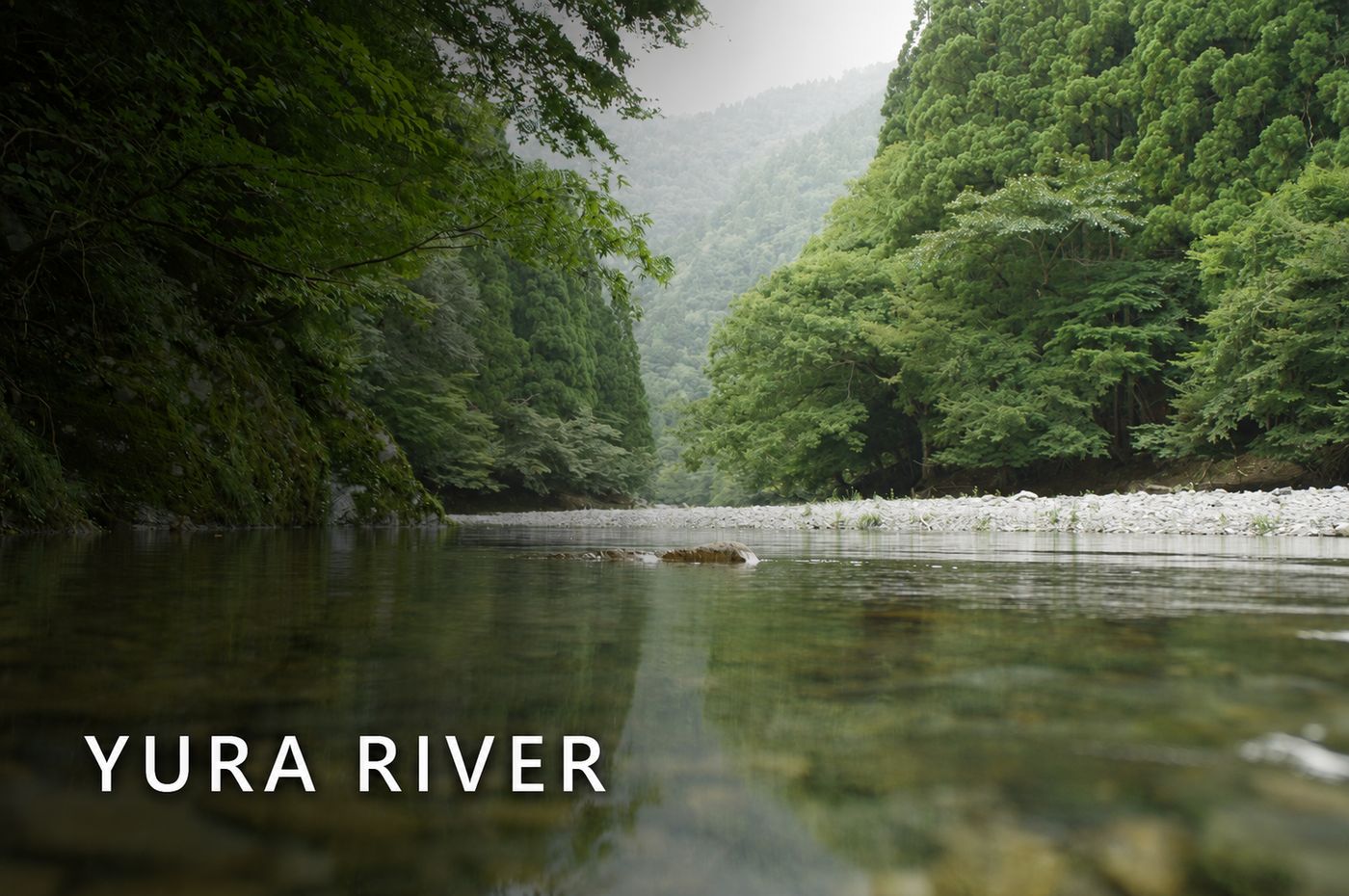
The river flowing through Miyama is called the Yura River.
It begins in the beautiful Ashiu Forest deep in the mountains of Miyama and flows about 146 kilometers all the way to the Sea of Japan.
For many years, Kyoto University has used the Ashiu Forest as a research forest. Because the area has been carefully protected, a rare untouched natural forest still remains here today.
The Yura River is one of the most important rivers in Kyoto Prefecture.
In the upper area around Miyama, the water is very clean and clear, and many kinds of wildlife live here.
You can find fish such as:
- ayu sweetfish
- amago trout
- Japanese iwana trout
and also rare animals like the giant salamander and kajika frogs.
The river has supported local life for hundreds of years.
People have used it for:
- farming
- fishing
- transportation
- and daily life
The famous thatched-roof culture of Miyama is also connected to this rich natural environment.
Today, the Yura River is loved not only for its natural beauty, but also as an important part of Miyama’s SATOYAMA culture, where people and nature live together in harmony.
Another interesting side of the Yura River is ayu fishing.
The Yura River is famous among fishing lovers, especially for a traditional fishing style called “tomozuri,” or “friend fishing.”
Ayu are very territorial fish.
They try to chase away other ayu that enter their area.
Tomozuri uses this habit.
Fishermen use a live ayu as a decoy fish.
When another ayu attacks it, the fish gets caught on the hook.
It is a very unique Japanese fishing culture, and in summer you can often see fishermen standing in the river wearing special clothes.
Ayu are also called “sweetfish” in English because they have a fresh and slightly sweet smell, sometimes like watermelon or cucumber.
Interestingly, the taste of ayu changes depending on the river.
This is because each river has different:
water quality
water temperature
minerals
river flow
and different kinds of algae that ayu eat
Miyama’s Yura River is known for its very clean water and rich natural environment, so many people say the ayu here have an especially good flavor and aroma.
Here’s another interesting story about the connection between the forest, the river, and the sea.
In the Ashiu Forest near Miyama, many beautiful beech trees still remain.
In Japan, there is a famous saying:
“One beech tree can support 1,000 yellowtail fish.”
In Japanese, we say, “Buna ippon, buri senbiki.”
Of course, this is not a scientific number.
It simply means that healthy forests help create rich oceans.
Every autumn, leaves fall from the beech trees and become nutrients in the soil.
Rain carries those nutrients into small streams, then into the Yura River, and finally to the Sea of Japan.
These nutrients help plankton grow in the river and ocean.
Small fish eat the plankton, bigger fish eat the small fish, and this supports many kinds of sea life, including yellowtail fish, called “buri” in Japanese.
So in a way, people say the forest is raising the fish.
In Japan, it is quite common for fishermen to plant trees in the mountains.
This may sound surprising, because mountains and the ocean seem completely separate, but Japanese people have long understood that rich forests help create rich oceans.
Because of this idea, some fishermen in Japan actively plant trees to protect the rivers and oceans connected to their fishing areas.
There is even a famous Japanese saying:
“A rich forest creates a rich sea.”
This is one reason why forests like the Ashiu Forest near Miyama are considered so important, not only for the mountains and rivers, but also for the ocean far away.
The same thing happens in rivers around Miyama.
The clean water and nutrients from the forest help support many kinds of life, such as:
- ayu sweetfish
- amago trout
- char
- giant salamanders
- kajika frogs
- and many insects and birds
That is why forests like Ashiu are so important.
They are not only beautiful forests.
They also protect water, support wildlife, and even help the ocean far away.